


Post Webinar: A challenging, but not an impossible job
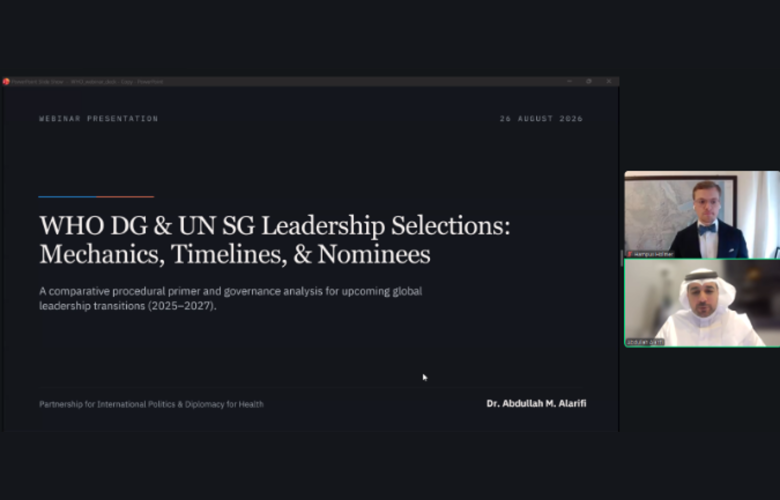
Both the next Director-General of the WHO and the next Secretary-General of the UN will inherit challenging, but not impossible jobs. The DG should focus on rebuilding trust in the institution by sharpening its mandate, addressing structural financing vulnerabilities, and finding new ways to work in a fragmented political landscape. The SG is faced with creating a more democratic UN and redefining the role of multilateralism, by speaking truth to power instead of defending the status quo.
That was the sentiment that was echoed during the webinar ‘Impossible Jobs’ organised by previous fellows of the International Politics and Diplomacy for Health Executive Programme on 26 August. The discussion went beyond speculation or endorsement of candidates. Instead, panellists discussed capabilities and characteristics the next DG and SG will need to manage the challenges they will be faced with.
Key takeaways for the next DG and SG
The challenges facing the next Director-General and Secretary-General cannot be solved by leadership alone, but require an enabling political, financial and institutional environment shaped by Member States. The WHO should not shy away from utilising coalitions of the willing and should strengthen regional cooperation with local powers while ensuring that sovereignty does not come at the expense of collective responsibility and accountability. Rebuilding trust is essential, and will require a sharper mandate, greater transparency, and recognition from other actors. Above all, the WHO must defend core principles such as equity and the independence of evidence from politics, particularly when doing so is inconvenient. The UN needs to be democratised to regain legitimacy and trust, to not be perceived as weakened by veto powers. This requires addressing difficult and unpopular questions within the existing political constraints and actively challenging the status quo.
The concluding question asked to the candidates is what trade-off they will confront, whose voice they will carry, and what core principle they will never let go off, even when it is inconvenient.
The webinar was organized by fellows of the International Politics and Diplomacy for Health Executive Programme, led by the Partnership for International Politics and Diplomacy for Health. The event was moderated by Dr. Hampus Holmer, and speakers included Dr. Abdullah Alarifi, Dr. Luchuo Engelbert Bain, Dr. Floramae Esapebong-Ray, Guilherme Duarte, Clélia-Elsa Froguel, Dr. John Nkengasong.
Stay up to date on events and our work via our News and LinkedIn.