


Provision of Global Public Goods for Health in a reformed international system for health

Global cooperation for health is entering a new era, as global health reform transitions from diagnosis to concrete action. The debates center on country ownership, health sovereignty and subsidiarity, leaving the question of the future role of the global level unsettled. Key actors argue that the international system’s comparative advantage lies in providing Global Public Goods (GPGs).
The debate lacks a shared understanding of what the GPGs for health are or how they are delivered, with reform proposals listing different GPGs as the priority of the global level. GPGs and global functions are often used interchangeably, even though not all functions produce a GPG. This ambiguity is not merely academic – how GPGs are defined shapes what gets prioritized, who governs and who pays.
Our new brief, Provision of Global Public Goods for Health, aims to provide clarity on key concepts of the reform (GPGs and global functions) and offer concrete examples of how the GPG framework can be used to analyze which functions should be prioritized.
GPGs are goods that are non-excludable, non-rival and global in scope. However, few goods fulfill the criteria in practice. Too narrow application means that few goods qualify, whilst too loose conceptualization diminishes its practical value.
To maximize the utility of the concept, we propose understanding GPGs as a continuum, ranging from pure to strong to partial GPGs, with fading “GPG-ness” up until a negotiated threshold (see figure).
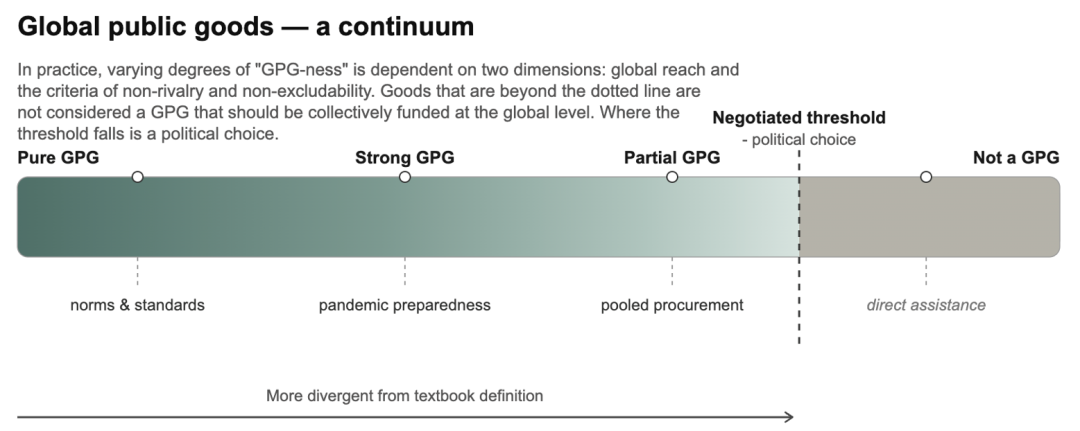
The key task ahead is to agree on how far from the textbook definition a good can diverge from the textbook definition and still be financed and provided collectively at the global level. The continuum also supports discussion on which functions are better delivered regionally or nationally. This is ultimately a political choice, not a technical classification.