


Light After Darkness: How Ukraine's Wartime Experience Is Strengthening European Preparedness
Health Bridge held its second online seminar building on the first seminar's foundational discussion of health diplomacy with a sharper, practical question: how does a country under daily attack also become a source of knowledge and support for others?
More than 90 people from 26 countries registered for the session. Around 30 took part. The gap was driven largely by conditions in Ukraine itself: massive blackouts across the country on the day significantly cut the number of Ukrainian participants able to join.
The seminar was opened by Prof. Tobias Alfvén, Vice-Dean for Doctoral Education at Karolinska Institutet, who stressed the role of academic institutions in shaping policy and the need to translate Ukraine's experience into research evidence.
The disruption was not only a backdrop. During the seminar, the presentation by Prof. Serhiy Dubrov — himself speaking from Ukraine on the realities of wartime care — was interrupted by a power outage mid-talk. The moment underlined, in real time, the exact condition the seminar had been convened to discuss: a health system continuing to function, and to generate knowledge, while its basic infrastructure is under attack.
The wartime paradox
Seminar 1, held on 21 April 2026, had left an open question on the table: why and how does a country under daily attack become a contributor to global health, rather than only a recipient of aid? The paradox was posed as two linked questions. Why does a country under daily attack choose to become a global health donor — what drives a nation to give knowledge to others while it is under threat? And how can a system in acute need generate knowledge others can use — where does the capacity to produce and share that knowledge come from?
Three perspectives
Four speakers carried the programme, moving from lived experience to regional and youth perspectives.
Prof. Olesya Hulchiy opened with a recap of Seminar 1 and introduced the paradox. Prof. Serhiy Dubrov, former First Deputy Minister of Health of Ukraine, then spoke on "Ukraine from within": a clinician, administrator and academic view of the health system under pressure. Prof. Dorit Nitzan, formerly WHO Representative in Ukraine and later WHO Regional Emergency Director for the European Region, followed with a regional perspective on moving from emergency response to health diplomacy. Natalia Pidmurniak, representing the Youth Council of Ukraine's Ministry of Health, closed the presentations with the youth perspective and the role of young people in shaping academic health diplomacy going forward.
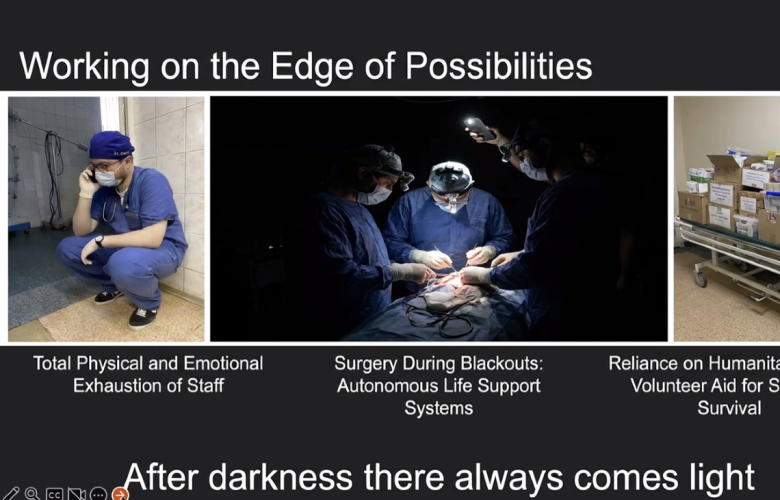
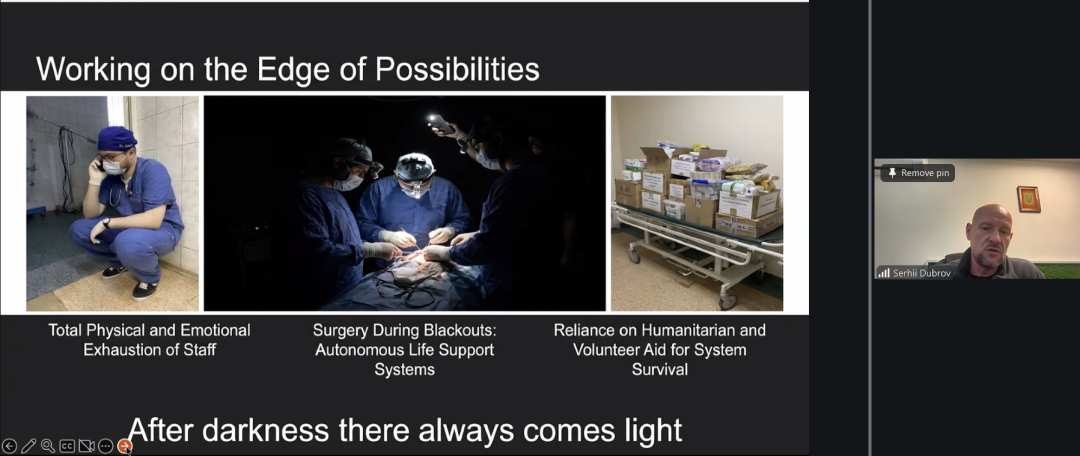
Serhiy Dubrov, speaking under the title "Working on the Edge of Possibilities," described a health system absorbing total physical and emotional exhaustion of staff, surgery carried out during blackouts on autonomous life support systems, and growing reliance on humanitarian and volunteer aid to keep services running. He set out the scale of displacement behind these conditions: 7 million internally displaced people, 73 medical facilities urgently relocated, around 4,200 medical workers forced to relocate and resume work elsewhere, and an 8% drop in registered medical workers in 2022. His closing line, "after darkness there always comes light," was delivered shortly before the outage that cut his own feed.
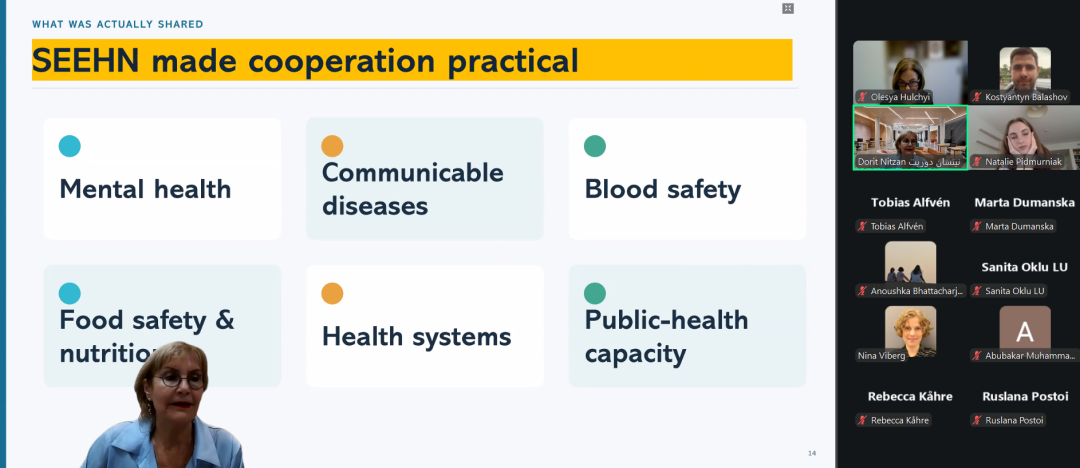
Dorit Nitzan traced the transformation from humanitarian response through recovery and trust-building to health diplomacy proper — negotiating cross-border rules, institutionalizing joint work, and building mutual health security — while insisting that "diplomatic ambition must never condition lifesaving care." She distinguished bilateral, multilateral and global instruments of health diplomacy, used the South-Eastern Europe Health Network's growth from a 2001 pledge into a durable institution as a regional case study, and named what Ukraine's experience has to share: hospital continuity under damaged infrastructure, mass-casualty systems, public-health intelligence under disruption, and academic continuity through training, research and international partnership. She closed with a proposed Health Bridge action agenda: a Ukraine-led learning consortium, one shared, jointly documented resilience case, a joint exercise to test the lessons, agreed data safeguards and fair authorship, and a named lead, deliverable and deadline.
Natalie Pidmurniak, speaking on "From Having a Seat to Shaping the Agenda: How Ukrainian Youth Medical Diplomacy Evolved During the War," addressed how young Ukrainian medical professionals and students have moved from participating in international forums to actively shaping their agendas during the war.
Participants offered their own answers on the main questions.
The international community's support in treating Ukrainian citizens, in Ukraine and abroad, has earned gratitude that itself motivates reciprocity. And having witnessed the risks of unprovoked aggression at first hand, Ukraine wants to share what it has learned about overcoming them — to strengthen regional and global security and reduce the chance of such losses recurring elsewhere.
Ukraine has preserved an integrated approach to health care that combines clinical work, research and education, allowing health and care delivery data to be documented and analyzed in real time as the experience unfolds. And the adaptations forced by wartime conditions — damaged facilities and infrastructure, power and water shortages — constitute practical, tested experience that can be readily adapted to other health systems facing comparable disruption.
Beyond the war response
The four presentations were followed by a panel discussion with all speakers, moderated by Prof. Hulchiy, before closing remarks and key takeaways.
Discussion also looked past the immediate war response. Prof. Oleg Shvets stressed that Ukraine's long-term health strategy cannot be defined by wartime emergency alone: the burden of non-communicable diseases — cardiovascular disease, cancer, diabetes and chronic respiratory conditions — continues regardless of the conflict, and keeping it in view was raised as a strategic priority alongside crisis response and reconstruction, so that gains made in emergency and academic resilience are not made at the expense of the chronic-disease agenda.
Prof. Ingrīda Rumba-Rozenfelde informed that the next Health Bridge seminar is scheduled for 28 January 2027 and will discuss the transformation of medical education amid crisis and uncertainty.
Health Bridge is a Swedish Institute-funded collaboration between Karolinska Institutet (Sweden), Bogomolets National Medical University, the National University of Life and Environmental Sciences of Ukraine, and the University of Latvia, building a health diplomacy network between the Baltic Sea region and Eastern Europe.